Posts

Showing posts with the label film

MCA: A Knock On a Hot Steel Tank!

Image
"How a movie ends must be a condensation of the director's attitude towards its events." Tawfik Saleh. Explaining realism, the late Egyptian filmmaker Tawfik Saleh said: "It is the picking up of details and personalities from real life and linking them with a certain 'concern' and presenting this in form and filmic presentation that will raise the awareness of the recipient of that concern." With only six or seven feature films, Saleh was able to rank high in the list of pioneers of realism in Egyptian cinema, along with Youssif Chahine , Salah Abuseif, etc. But Saleh was not a very happy filmmaker, not because of his own belief that he was hated 'in and out and for no obvious reason', but because of his trials and tribulations with authorities and bureaucracies of the Arab world in the late sixties and early seventies when the best production finances had to come from the 'public sector'- read the government! When he wrote the...

Luxor African Film Festival 2013

Image
Young African filmmakers listen to master Gerima Click here to see more photos by Egyptian photographer Hasan Amin The Luxor African Film Festival (LAFF) concluded its second edition Sunday March 24th 2013 in the historic Luxor city in Egypt. The festival ran in several venues in the city. It was characterized by workshops on filmmaking presented by Egyptian filmmakers under the guidance of Tunisian filmmaker Mr. Reda Elbahi. A fourth workshop was conducted by world-renowned Ethiopian master filmmaker Haile Gerima (maker of Teza , Sankofa etc.) Here is what LAFF organizers had to say about Gerima's contribution: ".. Haile Gerima's Workshop in Luxor is a big African and international occurrence. Youth of Africa will get an opportunity to gather and get to know more about each other; to discover their imaginations, perceptions and common issues and problems. As a result, a new generation of filmmakers will appear in our mother continent Africa. Accordin...

The Poetic Language of Cinema

Image
Final Part Meshes Of the Afternoon This film was produced in 1943 by Maya Deren and Alexander Hamid in Hollywood. It was described as trance film, with both subjective and dreamlike qualities. Unlike The Sky Over Berlin , it seems difficult to provide a short summary about the film, since it has no standard story line to be told. However, we can identify some patterns and movements in the film that are based on small fragmented tales . One is that of a young woman, played by Deren herself, who is looking from a window at a figure in dark dress with its face replaced by a mirror. The young woman, however, can see also herself following the figure, and once more herself following the two! The second fragment is of a man who opens the door of the same flat, finds the young woman and takes her up the stairs. These two fragmented pieces of minimal story elements are broken with similar sub-fragments. All these pieces seem to evolve around each other while the identity of each actor ...

The Poetic Language of Cinema

Image
  Through its century-long history of existence, cinematic expression has continued to reside, at least in its mainstream manifestations, in the domain of prose . The many possibilities for the articulation of meaning, with which the new medium was born, have lent themselves to the rationalistic nature of a particular kind of prose, namely that of narrative. What came to be known as Narrative cinema dominated the new medium and, influenced by the long history of literature and the novel, has assigned itself to a certain relationship with reality .[1]   It is indeed a legitimate question to investigate why cinema, and its language , has been deemed, since the early beginnings, as  a  narrator rather than a poet, while there are no innate proprieties that force such  a  characteristic upon the new medium. In the contrary, cinema in essence, we will argue, is rather a close relative to the traditions of poetry than those of prose. ...

Movie Critic Article: The Best Egyptian Movie

Image
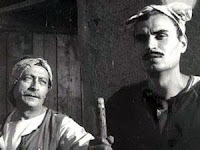
When asked in an online interview whether he thought Egypt would become “more free and liberal in the near future,” Chahine's reply was categorical and pessimistic: “No, neither in the near nor in the faraway future.” The Best Egyptian Movie A Film for yesterday, today and tomorrow. (As long as there are tyrants and rebels!) Article By: Badr Eddin Hassan Ali Seen and liked by thousands the world over, "The Land" 1969 by the late Egyptian master filmmaker Youssef Chahine, is considered one of the best Egyptian movies ever made. On a 1996 list of the best hundred Egyptian films prepared by cinema critics, "The Land" ranked number two; number one being the 1939 movie "Al-Aziema". "The Land"   tells the story of the struggle of the peasants against the landmasters in the thirties of last century in Egypt. It explores the sufferings of the peasants and their values and aspirations for a better life. It shows through an excellen...